Use case 0: Playing around with ShowerModel
[1]:
import showermodel as sm
import numpy as np
import matplotlib.pyplot as plt
Showers
Let’s generate a 1 TeV gamma-induced shower with 20 degrees zenith angle impacting 0.1 km east and 0.2 km north from some ground-based telescope located at 2.2 km above sea level.
[2]:
shower = sm.Shower(1.e6, theta=20., az=45., x0=0.1, y0=0.2, h0=2.2)
Shower contains information on the shower track geometry, energy deposit profile and both Cherenkov and fluorescence light production.
[3]:
#shower.track
shower.profile
#shower.cherenkov
#shower.fluorescence
[3]:
| X | s | dX | E_dep | N_ch | |
|---|---|---|---|---|---|
| 0 | 833.809519 | 1.639942e+00 | 20.886275 | 1745.333331 | 31.730952 |
| 1 | 813.133112 | 1.621252e+00 | 20.467949 | 2162.692406 | 40.159662 |
| 2 | 792.870827 | 1.602432e+00 | 20.058002 | 2655.502849 | 50.365789 |
| 3 | 773.014371 | 1.583483e+00 | 19.656266 | 3231.401894 | 62.600293 |
| 4 | 753.555613 | 1.564409e+00 | 19.262576 | 3897.468497 | 77.120065 |
| ... | ... | ... | ... | ... | ... |
| 545 | 0.000096 | 4.178872e-07 | 0.000021 | 0.000009 | 0.090310 |
| 546 | 0.000075 | 3.250234e-07 | 0.000021 | 0.000009 | 0.090309 |
| 547 | 0.000054 | 2.321596e-07 | 0.000021 | 0.000009 | 0.090308 |
| 548 | 0.000032 | 1.392957e-07 | 0.000021 | 0.000009 | 0.090307 |
| 549 | 0.000011 | 4.643192e-08 | 0.000021 | 0.000009 | 0.090305 |
550 rows × 5 columns
This object also has some atributes and methods to make calculations and plot data.
[4]:
X_max = shower.X_max
x, y, z = shower.track.X_to_xyz(X_max)
print("Depth of maximum (g/cm^2):", np.around(X_max, 3))
print("Height of shower maximum (km):", np.around(z, 3))
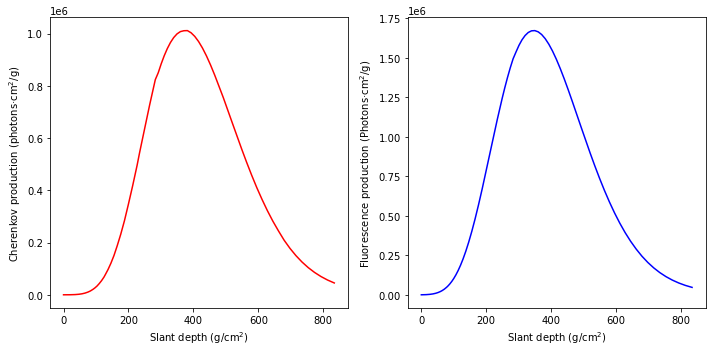
shower.show_light_production();
Depth of maximum (g/cm^2): 345.753
Height of shower maximum (km): 6.61
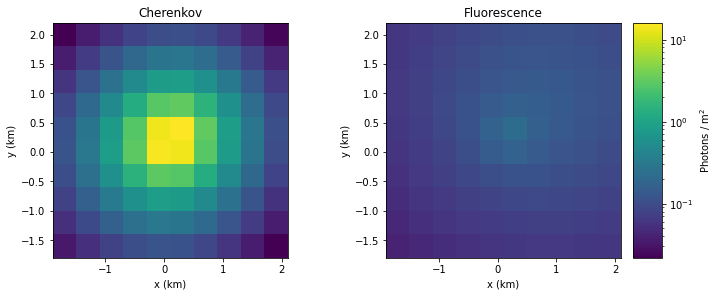
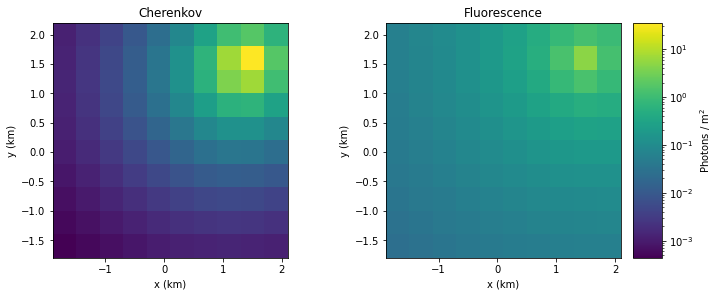
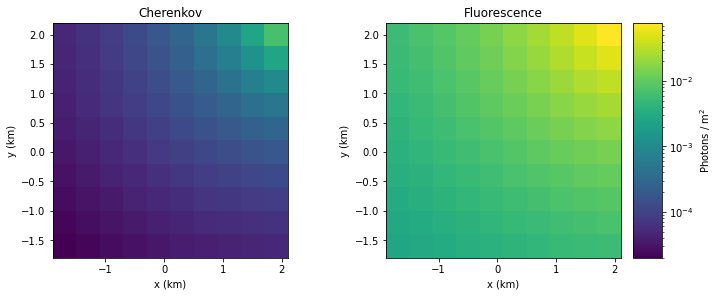
For example, you may be interested in evaluating the photon density on horizontal planes at different heights (0, 5 and 10 km above ground level). A full MC simulation would take a long time, but ShowerModel allows you to do this calculation in a relatively short time.
[5]:
for z in [0., 5., 10.]:
    shower.show_distribution(x_c=shower.x0, y_c=shower.y0, z_c=z, size_x=4., size_y=4., N_x=10, N_y=10);
Observatory events
Now, we can generate an observatory consisting in a 500 m radius circular array of 25 IACTs pointing at the shower arrival direction. There exists a function to do that with default telescope parameters.
[6]:
observatory = sm.Array25(R=0.5, theta=20., az=45.)
observatory.show();
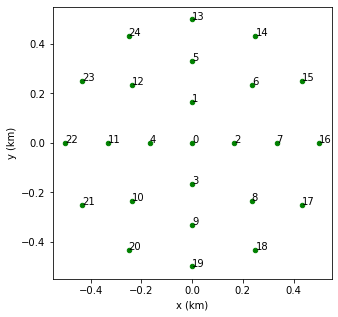
Some characteristics of the default IACT.
[7]:
print("Angular aperture (deg):", observatory[0].apert)
print("Number of pixels:", observatory[0].N_pix)
print("Collection area (m^2):", observatory[0].area)
print("Position of telescope #8 (km):", np.around([observatory[8].x, observatory[8].y], 3))
Angular aperture (deg): 8.0
Number of pixels: 1800
Collection area (m^2): 113.097
Position of telescope #8 (km): [ 0.236 -0.236]
An Event object can be generated from the above-defined Shower and Observatory objects.
[8]:
event = sm.Event(shower, observatory)
It contains the shower track projection and signal at each telescope.
[9]:
event.projections[8]
#event.signals[8]
[9]:
| distance | alt | az | theta | phi | beta | time | FoV | |
|---|---|---|---|---|---|---|---|---|
| 0 | 0.485012 | 11.967679 | 346.617250 | 68.268420 | 16.959319 | 68.268420 | 1.015937 | False |
| 1 | 0.598276 | 30.285485 | 353.548306 | 48.856659 | 16.959319 | 48.856659 | 0.679743 | False |
| 2 | 0.756485 | 41.661785 | 359.362985 | 36.553427 | 16.959319 | 36.553427 | 0.493467 | False |
| 3 | 0.937146 | 48.696291 | 4.216889 | 28.734994 | 16.959319 | 28.734994 | 0.382082 | False |
| 4 | 1.129536 | 53.258711 | 8.275287 | 23.507737 | 16.959319 | 23.507737 | 0.309824 | False |
| ... | ... | ... | ... | ... | ... | ... | ... | ... |
| 545 | 116.839319 | 69.901311 | 44.423409 | 0.220937 | 16.959319 | 0.220937 | 0.000024 | True |
| 546 | 117.053371 | 69.901493 | 44.424458 | 0.220533 | 16.959319 | 0.220533 | 0.000018 | True |
| 547 | 117.267422 | 69.901675 | 44.425504 | 0.220131 | 16.959319 | 0.220131 | 0.000013 | True |
| 548 | 117.481474 | 69.901856 | 44.426545 | 0.219730 | 16.959319 | 0.219730 | 0.000008 | True |
| 549 | 117.695525 | 69.902036 | 44.427583 | 0.219330 | 16.959319 | 0.219330 | 0.000003 | True |
550 rows × 8 columns
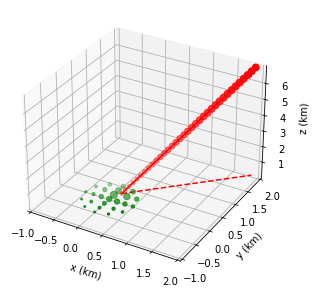
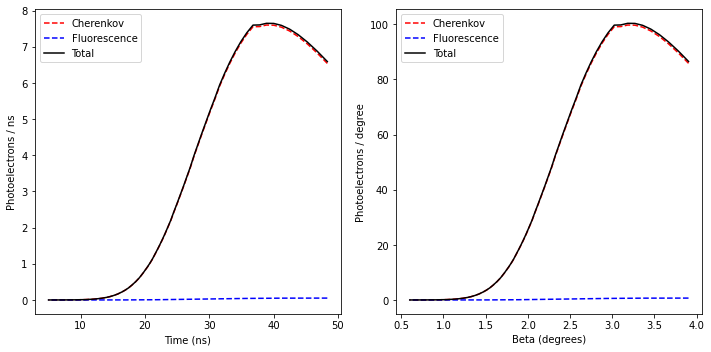
There are methods to visualize the event geometry and time evolution of signals.
[10]:
event.show_geometry3D(x_min=-1., x_max=2., y_min=-1., y_max=2.);
event.signals[8].show();
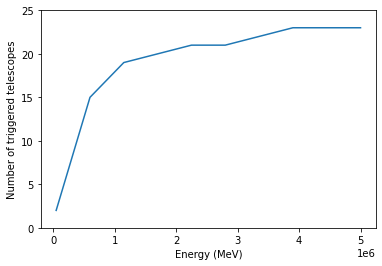
For example, you may want to obtain the number of telescopes having an integrated signal greater than 100 photoelectrons as a function shower energy. Below, observatory events are generated for 10 showers with energies from 50 GeV to 5 PeV. The trigger condition is evaluated for each telescope of the observatory (25 telescopes). Calculations may take a while.
[11]:
energy = np.linspace(50.e3, 50.e5, 10)
trig_tel = np.zeros_like(energy)
for (i, E) in enumerate(energy):
    event = sm.Event(shower.copy(E=E), observatory)
    Npe_sum = np.array([event.signals[tel].Npe_total_sum for tel in range(25)])
    trig_tel[i] = len(Npe_sum[Npe_sum>100])
plt.plot(energy, trig_tel);
plt.xlabel("Energy (MeV)");
plt.ylabel("Number of triggered telescopes");
plt.ylim(0, 25);
Camera images
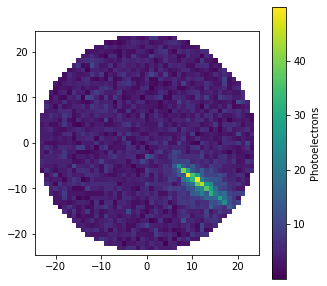
Camera images (actually, image sequences) are generated assuming a Nishimura-Kamata-Greisen lateral distribution of electrons in the shower. A night sky background of 40 MHz/m\(^2\)/deg:math:^2 is assumed by default, but this parameter can be changed. The integration time (in \(\mu\)s) per camera frame can be set too.
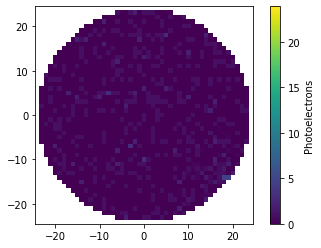
In the example below, the integrated image is shown for one of the telescopes (tel_index=12) of the observatory. The camera has 1800 pixels (default). Then, the image sequence (17 frames) is shown.
[12]:
image = sm.Image(event.signals[12], int_time=0.002)
image.show();
[13]:
image.animate()
[13]:
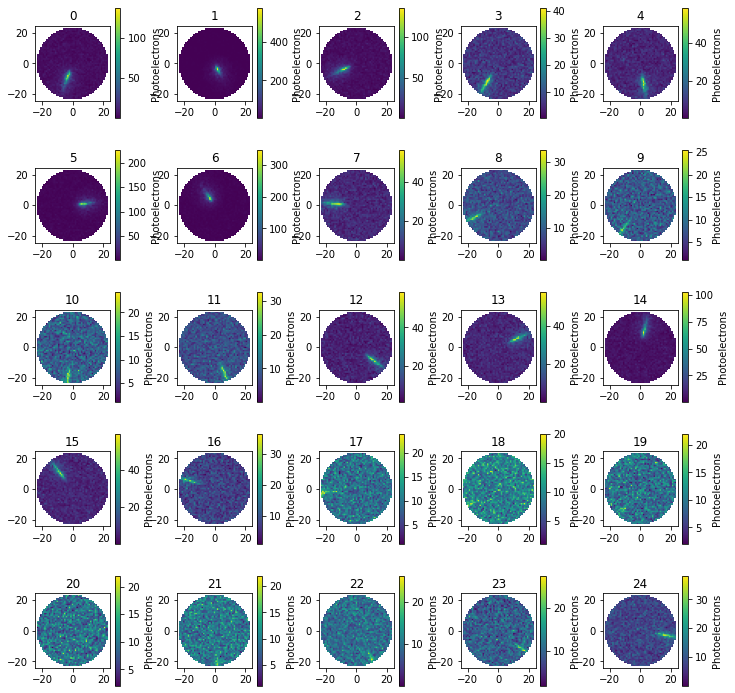
Event includes a method to show the images of all the telescopes in the same figure. Again, calculations may take a while, because there are 25 telescopes with 1800 pixels each, and each image is the sum of several frames.
[14]:
event.make_images(NSB=50.)
event.show_images();
[ ]: